Last fall, I started a class in neon glass at Milwaukee Makerspace. Our instructor Brett took only a few minutes to do brief introductions to one another and his co-instructor, Rosie, before he led us into a meeting room to view a presentation on neon. He didn’t tell us how we would need to work. He barely mentioned safety. He said nothing of the history, prevalence, rarity, or challenges of neon.
No, Brett showed us slide after slide of art featuring neon tubes. He spoke in terms we mostly didn’t understand and about color effects that I could barely see because I am partially color blind. But he showed us work he admired, work completed by former students, and work he created.
One piece featured a kite backlit with neon with a fanciful twisted neon tube forming its tail. The kite was positioned behind a panel of chain link fence. Just as the fence captured the kite, suggesting that the wind was its nemesis, so too did the sculpture capture me. In a week we would need to return to class with an idea for a work we could complete in a few months. Brett also asked us to decide if we wanted to do a one-off piece, launch a maker’s practice in sign making, or incorporate neon into multimedia art sculptures.
What the hell!
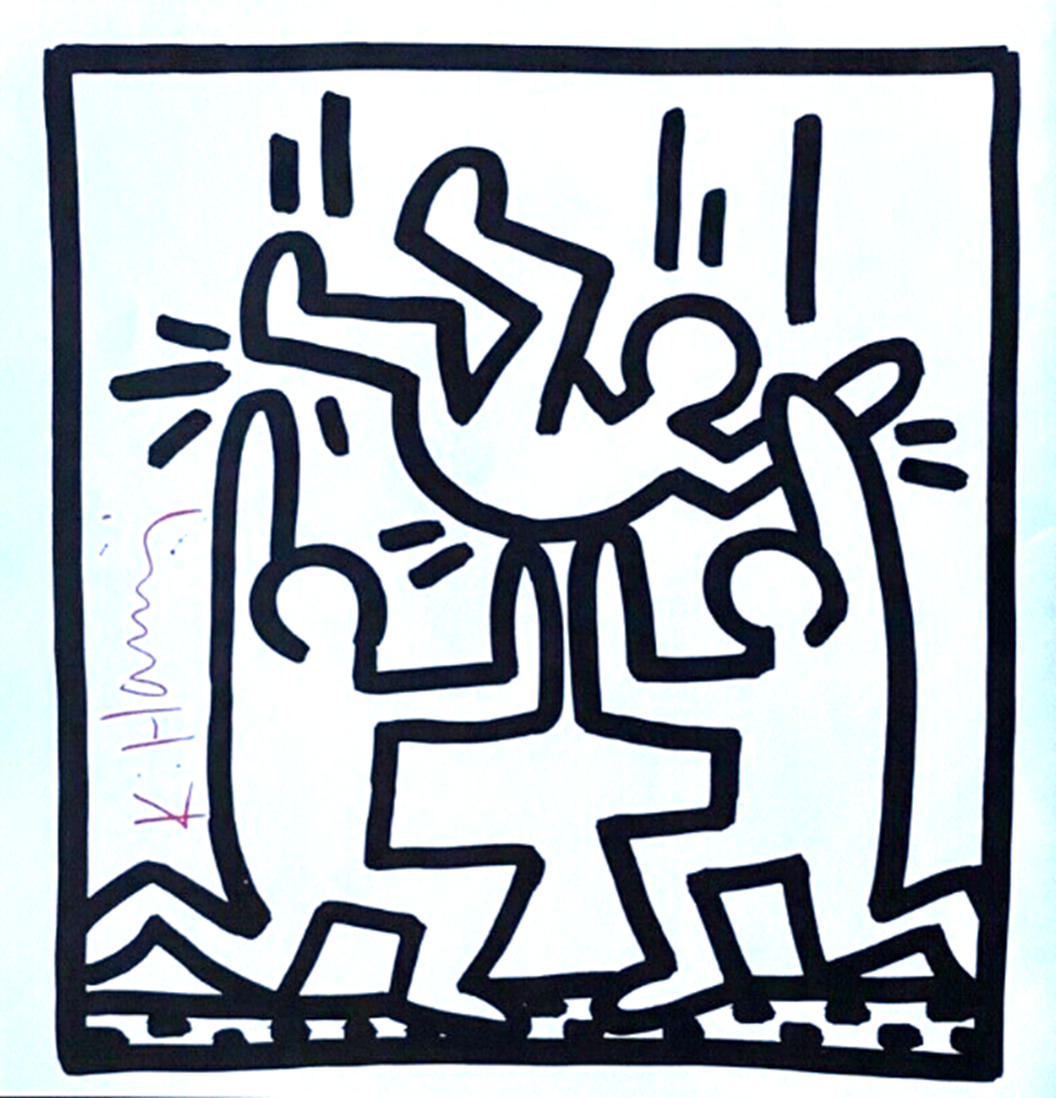 With that bug in my brain, I came up with a design that incorporated part of a Keith Haring work that had captured me decades ago. I thought about how the HIV epidemic – our gay pandemic – forever shifted my work in the world. During its early days, I returned to school to get a PhD in psychology, doing a dissertation about the emotional resilience of gay and bisexual men with HIV. My friend Jan and I went to the County Hospital to meet the first identified patients, among them Larry, a man who, along with his partner Marty, became focal points of me and my own new partner, Paul. We stayed at the side of both these men for over 10 years as they lived with AIDS.
The sculpture also needed to include me. HIV didn’t happen to me. Nor have I been a bystander. I decided that I would not be idle while this virus took my chosen family, my friends, my community. My first professional practice was directing an HIV mental health clinic and then an HIV medical clinic. When cryptosporidium was found in our drinking water, scores of our patients died within months and many, many more over the next year. My medical colleagues Mary, Karen, Ian, and Brian walked in a compassionate and overwhelmed daze as they cared for these men until the end.
Those experiences and many more prompted me to address anti-gay and racist oppressions that put so many people at risk. Thirty-five years ago, I was studying the social determinants of health and its implications for gay and bisexual men of color. It echoed my undergraduate fascination with the precepts of Alfred Adler, pointing to society as the nexus of our distress and health. That work led me to seek a state grant to address the HIV prevention needs of LGBTQ people, particularly People of Color. A group of queer teens met with me asserting that they were resilient and as different from one another as could be. Their counsel informed the name of project I launched 29 years ago, a project that became its own public benefit organization in 2002 – Diverse and Resilient.
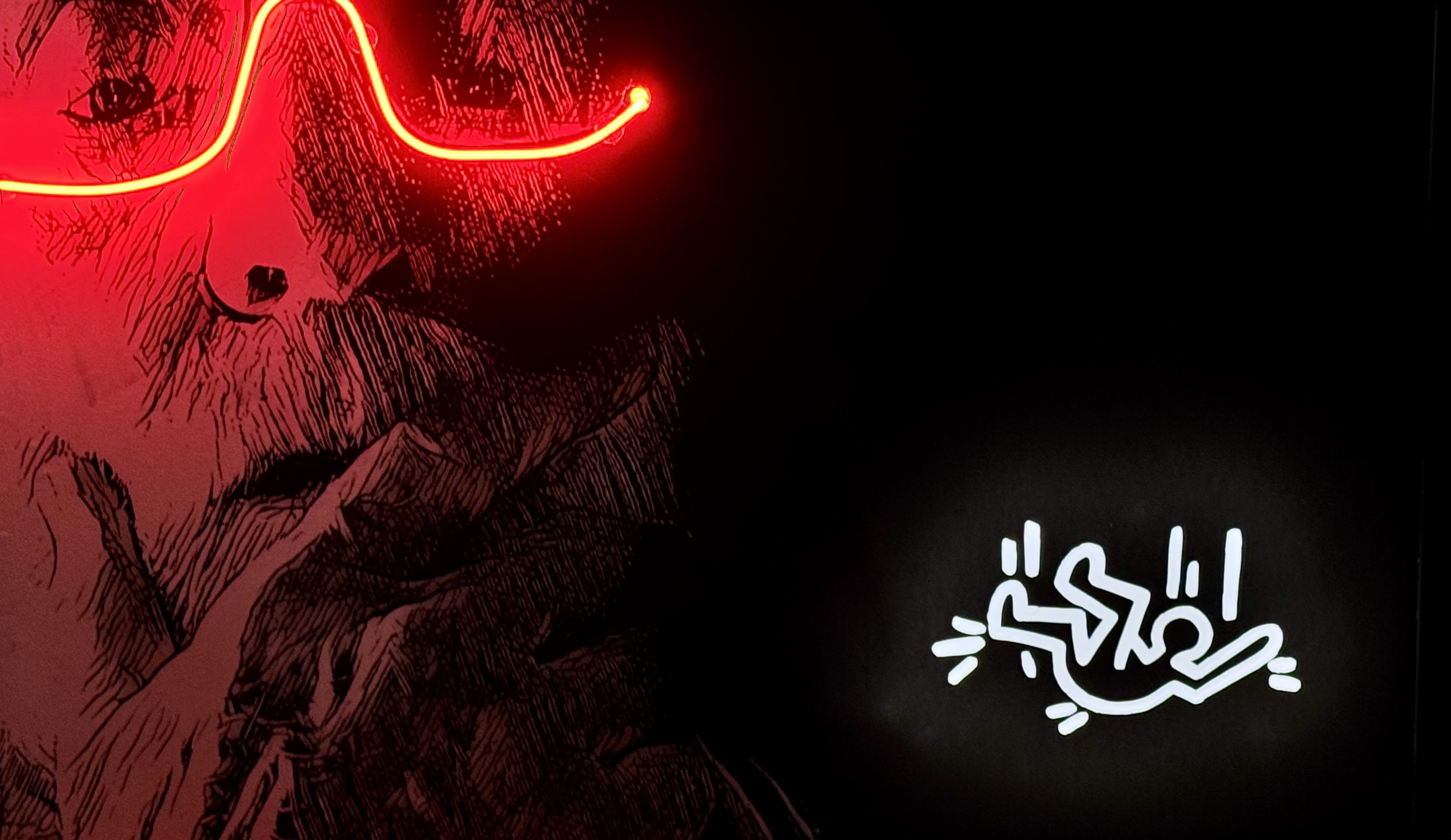
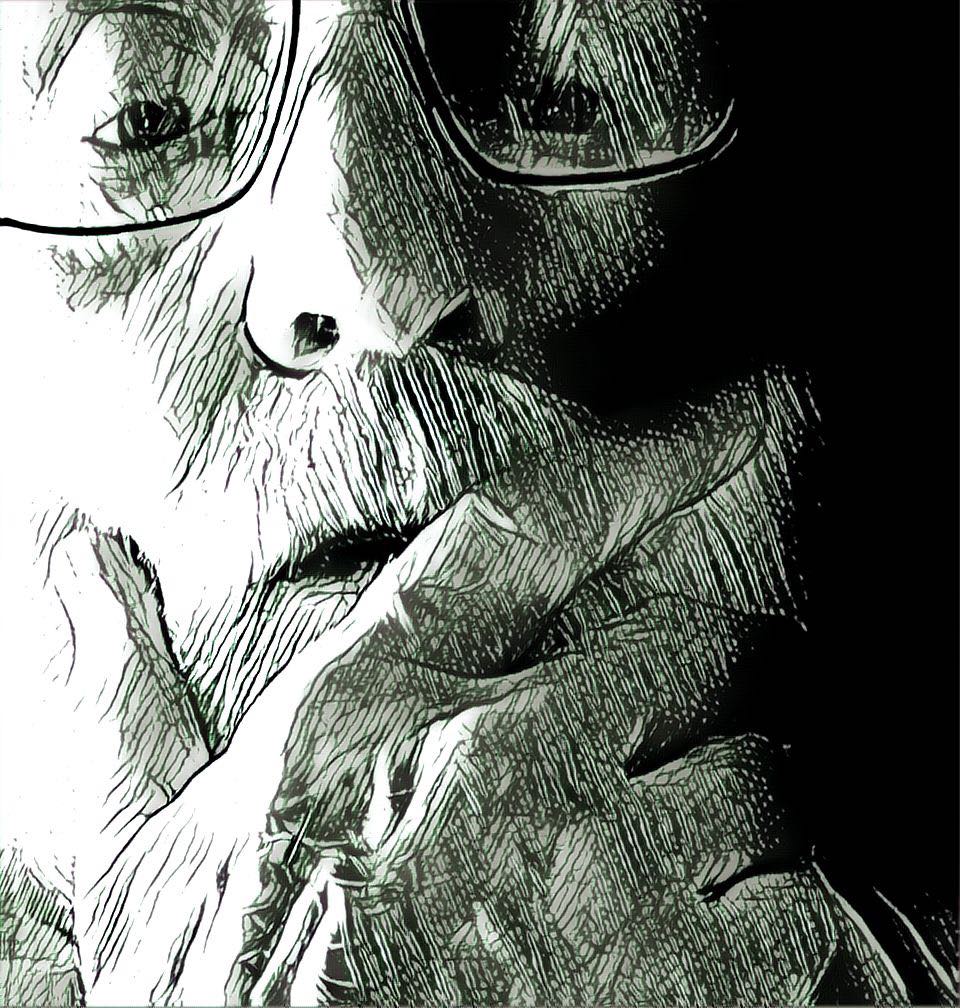 To illustrate this history, I elected to include in the sculpture an illustration of myself gazing at the Haring Falling Man. I opted to illuminate the Haring from the back of a plexiglass panel upon which the portrait was affixed. Then, to emphasize my decision to witness actively, I bent tubing to form the frame of my glasses, poking one end through the plexiglass portrait and wrapping the other around the wooden frame that holds the piece.
The technical aspects of the sculpture are complex, at least for me as a novice. But the personal correlates are, too. For example, I have gained a greater understanding that witnessing is not passive. It is active engagement, sometimes done in silence. Even that silence may involve talking, but it is the other person’s voice – and when my voice is included, it seeks to express presence to the other. Witnesses may not be able to catch us, but they can hold us.
So, as this project which I began in 2023 as a neon sculpture about me being caught in the wind of a pandemic has been completed, it has become for me another story, too. This spring marks the 60th anniversary of my coming out as a gay man, a declaration I made to my parents at nearly 16, five years before Stonewall.
This is a self-portrait of me.
In it, I am looking at childhood poverty, my mother being ignored in stores, my father on strike, Stonewall, Vietnam, Donna Summer, Tchaikovsky, Juneau Park, Pride Parades and Festivals, funerals, families asking for money on street corners, condom distribution, disappointing community partner agencies, tolerance instead of celebration, crucifixes in hospital rooms, macaroni, and limited nursing home visitation rights. I also see a spectacular array of wonderful people of all ages with many interests and affiliations.
If you look closely at the self-portrait and do not see the chain link fence that inspired it, it is likely because in some way we have joined each other on this side of that divide.
Thanks to my neon instructors, Brett and Rosie, and the other students in the class – Devon and Rick. Your knowledge, skill, patience, and encouragement were exactly what I needed to find this success in me. Thanks, too, go to wood shop champions, Rick, Kyle, and Chris, who taught me how to safely use heavy duty equipment to create a custom frame with sufficient strength and scale to hold the structural components of this work. Then, too, there is my cheer team: Ben, Jonathan, Maya, Sindie, Tim, and Zoriana. Finally, thanks go to Dan for his leadership of Milwaukee Makerspace where community supports the development of skills and humans.

